
Conference interpretation is the real-time delivery of spoken language across languages so every delegate at a multilingual event follows the proceedings as they happen, usually through soundproofed booths, wireless headsets, and interpreters working in pairs. Professional Interpreting Canada provides this service in 500+ languages, backed by ATIO certification, for international summits in Toronto, hybrid Annual General Meetings across Canada, and government training sessions running in a dozen languages at once. Our certified interpreters and translators work to the professional standards that high-stakes events demand, on-site, remote, or hybrid.
Conference interpreting is its own discipline. It demands different skills, different equipment, and far more planning than community or legal interpreting, and getting any of those three wrong shows up the moment the first speaker starts. This page walks through what the work actually involves: the three modes of interpretation, ISO booth standards, remote simultaneous interpretation (RSI), team sizing, and everything you should prepare before the podium mic goes live.
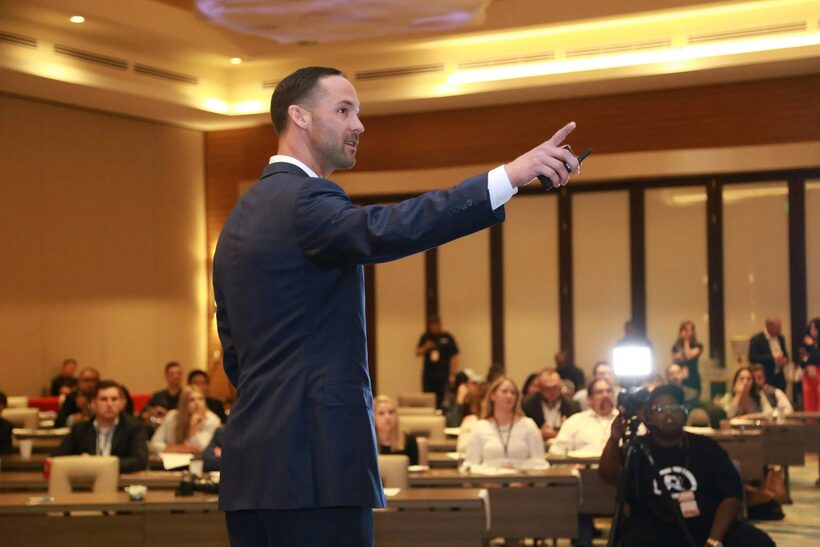
What Is Conference Interpretation?
Conference interpretation is the real-time conversion of spoken language from one tongue into another so that every participant in a multilingual meeting can follow proceedings without delay. It differs from translation, which deals with written text, and from community or court interpreting, which typically involves one-on-one or small-group settings. At its core, conference interpretation is about managing the flow of a live event where speakers address an audience, and where any break in comprehension breaks the event itself.
There are three principal modes of interpretation used in conference settings: simultaneous, consecutive, and whispered (chuchotage). Each has distinct technical requirements, appropriate use cases, and cost implications. Choosing the right mode is the first decision in planning a successful multilingual event.
The Three Modes of Interpretation: Simultaneous, Consecutive & Whispered
Simultaneous Interpreting
In simultaneous interpretation, the interpreter renders speech into the target language in real time while the speaker is still talking, maintaining a lag of only a few seconds. Listeners receive the interpretation through wireless receivers and headsets; the interpreter works inside a soundproofed booth so their voice does not disrupt the room. This is the mode used at the United Nations, the European Parliament, large international conferences, and multilingual summits, wherever speed, scale, and audience comfort are paramount.
Simultaneous interpreting is the most cognitively demanding mode. The interpreter must listen, comprehend, translate, and speak almost simultaneously while tracking cultural nuance, technical vocabulary, and the speaker’s pacing, all at once. This is why professional standards and practical experience both require that interpreters work in pairs per language, rotating every 20 to 30 minutes to maintain quality throughout a full day’s proceedings. Research consistently shows that accuracy and fluency degrade significantly beyond that interval. A team of two per language direction is therefore the baseline for any simultaneous assignment.
For more detail on how this mode compares to consecutive, see our FAQ: What is the difference between consecutive and simultaneous interpreting?
Consecutive Interpreting
In consecutive interpretation, the speaker delivers a portion of their remarks, typically a paragraph or a few minutes, then pauses while the interpreter reproduces the message in the target language. The interpreter uses detailed notes taken during the speaker’s delivery to reconstruct the full meaning accurately. No special equipment is required beyond a microphone if the room is large.
Consecutive interpreting is well suited to settings where precision is paramount and time pressure is lower: bilateral negotiations, medical or legal depositions, press conferences with Q&A, executive interviews, and smaller workshop sessions. Because the interpreter speaks after the original, the total speaking time is roughly doubled, a consideration when planning agendas. For events where multiple languages run in parallel or where audience size makes individual delivery impractical, simultaneous interpreting is usually the better choice.
Whispered Interpreting (Chuchotage)
Chuchotage, from the French verb chuchoter, to whisper, is a form of simultaneous interpretation in which the interpreter sits or stands beside one or two listeners and quietly delivers the interpretation directly into their ear, in real time. No booth is required, and no receiver equipment is needed for small groups.
Whispered interpreting is appropriate when only a small number of attendees at an otherwise monolingual meeting need assistance in another language, for instance, two visiting delegates at a board meeting conducted in English who require French interpretation. It is unsuitable for large rooms, noisy environments, or situations where more than two or three individuals need interpretation. For larger groups, a portable interpreter console and wireless receivers provide a more comfortable and acoustically sound solution.
See also: What is an example of interpreting services?
Equipment: Booths, Headsets, Receivers & ISO Standards
Professional simultaneous interpretation depends on the right equipment, and on that equipment being properly installed, tested, and managed. Cutting corners on equipment directly undermines interpretation quality and can create legal or compliance exposure for regulated events such as government hearings or AGMs.
Interpreter Booths: ISO 2603 & ISO 4043
Interpreter booths must meet internationally recognised standards to ensure acoustic isolation, sight lines, and a functional working environment. The two key standards are:
- ISO 2603:2016, Permanent (fixed) booths. These are built-in booths installed in purpose-built conference facilities. Requirements include a minimum floor area of 2.4 m² per interpreter, a minimum width of 1.6 m, a minimum depth of 1.5 m, and a ceiling height of at least 2 m. The A-weighted sound pressure level inside must not exceed 35 dB. Ventilation must achieve at least seven air renewals per hour, and temperature must be controllable between 18°C and 22°C to keep interpreters comfortable during long assignments.
- ISO 4043:2016, Mobile (portable) booths. Portable booths are used in venues that do not have built-in facilities. They are manufactured to be dismantled, transported, and re-erected while still meeting the acoustic and dimensional requirements adapted from ISO 2603. Mobile booths are the standard solution for hotel conference rooms, convention centres, and temporary event spaces.
Each booth is equipped with an interpreter console featuring microphones, volume controls, channel selectors for relay interpreting (interpreting from another language rather than the original), a cough button, and an intercom to communicate with the audio-visual team. Interpreters also have a monitor or direct sightline to the speaker, which is essential, visual cues (slide changes, gestures, facial expression) carry information the interpreter must convey.
Audience Receivers & Headsets
Delegates select their preferred language channel on a wireless receiver, a small, lightweight device distributed at registration, and plug in a single-ear or double-ear headset. Modern infrared and FM-based distribution systems support multiple language channels simultaneously, so a conference with three working languages requires only one set of hardware per delegate.
Receiver systems must be planned for the size of the room and the number of delegates. A licensed audio-visual technician should be present throughout the event to manage distribution, troubleshoot equipment failures, and adjust sound levels. Our project coordinators can advise on equipment rental partners and AV technicians where required.
Interpreter Consoles & Floor Microphones
The quality of what the interpreter hears is as important as what the audience hears. Conference microphones at the lectern and on discussion tables must feed cleanly into the booth without echo, room noise, or level drops. Poor floor audio is one of the leading causes of interpretation errors and interpreter fatigue. Testing the audio feed into the booth before the event begins is not optional, it is a professional requirement.
Remote Simultaneous Interpretation (RSI)
Remote simultaneous interpretation (RSI) brings the same professional quality of booth-based simultaneous interpreting to virtual and hybrid events, without physical booths, without interpreter travel, and without geographic constraints. Interpreters connect to a secure cloud-based platform, view a live video feed of the event, and deliver their interpretation in real time. Participants access their chosen language channel directly on their smartphone, laptop, or tablet, often simply by scanning a QR code or clicking a link.
RSI platforms can integrate with the major web conferencing tools, Zoom, Microsoft Teams, Webex, Google Meet, as well as dedicated virtual event platforms. This makes RSI the natural choice for:
- Fully virtual conferences and multilingual webinars
- Hybrid events where in-person and remote delegates attend simultaneously
- Organisations that want to reduce event costs by eliminating booth installation and interpreter travel
- Multi-city or multi-country training sessions with participants in different time zones
The cognitive demands on RSI interpreters are at least as high as in the traditional booth, some research suggests the added cognitive load of working from a screen rather than a glass-fronted booth makes RSI marginally more taxing. The professional standard of two interpreters per language pair therefore applies with equal force in the RSI context. Our RSI assignments are staffed with experienced interpreters who have specific training in the remote environment. For one-to-one and small-group remote work outside the conference setting, see our video remote interpreting service.
Learn more: Simultaneous French interpretation across Canada
Event Types We Serve
Our conference interpretation services cover the full range of multilingual events held in Ontario and across Canada. If your event brings together participants who speak different languages, we have the interpreters and the organisational experience to make it work.
International Conferences & Summits
Large-scale conferences, academic symposia, professional association meetings, trade and industry summits, diplomatic forums, require simultaneous interpretation with full booth setups, multiple language pairs, and experienced conference interpreters. We coordinate team assignments, relay interpreting where required, and work with your AV supplier to ensure smooth integration from technical rehearsal to final session.
Annual General Meetings (AGMs)
Publicly traded companies, cooperatives, and federal corporations with bilingual or multilingual shareholder bases are often legally required to provide interpretation at AGMs. Our interpreters are familiar with the procedural language of corporate governance, motions, amendments, points of order, voting resolutions, and can handle both the formal presentation portion and the open Q&A period. We serve AGMs in Toronto, Hamilton, and via RSI for virtual shareholder meetings.
Government & Regulatory Hearings
Federal and provincial governments, regulatory bodies, and public agencies are required to conduct proceedings in both official languages and, depending on the context, in Indigenous languages or the languages of participants. The federal Translation Bureau at Public Services and Procurement Canada provides simultaneous interpretation for Parliament and federal institutions, which sets the benchmark for this kind of work in Canada, and section 14 of the Canadian Charter of Rights and Freedoms guarantees the assistance of an interpreter to anyone who does not understand the language of a proceeding. Our certified interpreters are equipped to handle the formal register and technical vocabulary of parliamentary, regulatory, and administrative proceedings. We also support public consultations, town halls, and community engagement events conducted in multiple languages.
Corporate Training & Workshops
Multinational corporations and organisations with multilingual workforces need training that reaches every employee in the language they understand best. Whether the session is in-person or virtual, our interpreters ensure that the substance and nuance of the training content, including technical instruction, safety protocols, and compliance guidance, is accurately conveyed in every working language.
Legal Depositions & Arbitrations
High-stakes legal proceedings often involve witnesses or parties who are not fluent in English or French. Consecutive interpretation is the standard for depositions and examinations for discovery, as it allows parties to verify accuracy before proceeding. For large arbitrations with multiple language panels, simultaneous interpretation may be appropriate. Our legal interpreters understand the procedural requirements and standards of accuracy that legal proceedings demand. See also our court interpreters in Hamilton and certified translation services in Toronto.
Multilingual Webinars & Virtual Events
Virtual and hybrid events are now a permanent feature of the conference landscape. RSI lets webinars and online panel discussions reach audiences in any language without asking interpreters or delegates to travel. We coordinate multilingual webinars on every major platform and provide the technical guidance that keeps the participant experience smooth from login to sign-off.
Academic & Research Conferences
Academic conferences, particularly in fields like medicine, law, and sciences, require interpreters with specialist subject knowledge. We match interpreters to subject areas and provide pre-event terminology preparation so that technical papers, clinical presentations, and research findings are rendered accurately across language barriers.
Our ATIO-Certified Conference Interpreters
The quality of conference interpretation is ultimately determined by the quality of the interpreters. Credentials matter, and in Ontario, the standard that matters most is ATIO certification.
The Association of Translators and Interpreters of Ontario (ATIO) is the only professional association in Ontario empowered by law to confer the title of Certified Conference Interpreter. ATIO is the only body in the province with the legislative authority to grant this designation. There is no certification examination for conference interpreters; instead, candidates apply through a rigorous on-dossier process, providing documentation of their education and professional experience attested to by employers and clients. Recognised training pathways include graduate programs in conference interpretation at institutions such as the University of Ottawa and Glendon College, York University.
ATIO is the Ontario member of the Canadian Translators, Terminologists and Interpreters Council (CTTIC), the national body that oversees professional certification across the country. Working with ATIO-certified interpreters provides measurable assurance: you know the interpreter has met independently verified standards of competence, not just self-reported experience. For regulated proceedings, government sessions, AGMs with compliance requirements, court-adjacent proceedings, ATIO certification is often an explicit requirement or a strong professional expectation.
Learn why certification matters: The importance of a certified interpreter. For a broader view of our credentials, visit our ATIO-certified translation page.
Professional Interpreting Canada works exclusively with interpreters whose credentials have been verified and whose performance in the relevant mode, simultaneous, consecutive, or RSI, meets the standard demanded by professional conference work. We do not place unqualified bilingual speakers in interpretation booths.
Interpreter Team Sizing: Why Two Per Booth Is the Baseline
Clients sometimes ask why a full-day conference in two languages requires four interpreters rather than two. The answer is grounded in cognitive science and professional ethics, not in convention.
Simultaneous interpretation is among the most cognitively demanding tasks a human being performs professionally. The interpreter must simultaneously: listen to the source-language speech; parse its meaning in real time; formulate the equivalent in the target language; speak that equivalent aloud while continuing to listen; track pace, tone, and emphasis; manage terminology; and monitor their own output for accuracy. This parallel processing creates acute mental fatigue.
Research and the experience of professional associations, including the International Association of Conference Interpreters (AIIC), consistently show that after 20 to 30 minutes of continuous simultaneous work, even highly trained interpreters experience measurable degradation in accuracy, response time, and fluency. The two-interpreter rotation solves this: while one interpreter is active in the booth, the partner follows along and is ready to take over, usually with a quiet tap on the shoulder when the rotation point arrives. The audience never hears the switch.
For events exceeding seven or eight hours, or for events with extremely high terminological density, a full-day medical congress, for instance, a team of three per language may be appropriate. Our project coordinators will recommend the appropriate team size when you request a quote.
Conference Interpretation Planning Checklist
Successful multilingual events do not happen by accident. The following checklist reflects what we ask every client to consider before an assignment begins. Working through it early, ideally four to six weeks before the event, avoids the most common problems.
Languages & Language Pairs
- How many languages are needed? Identify every language that will be used by speakers and that delegates will need to understand. Do not assume that one direction covers the other, a conference in English and French where some delegates need English-to-French and others need French-to-English requires interpreters active in both directions.
- Are there minority or Indigenous languages? Some events, particularly government consultations and community hearings, require Indigenous language interpretation. Lead time for these assignments is typically longer. See our full languages page for the range of languages we support.
- Is relay interpreting required? When a language pair is rare, it may be necessary to interpret first into a pivot language (often French or English) and then relay into the final target language. This requires careful coordination of interpreter teams and equipment.
Event Format & Schedule
- What is the mode? Confirm whether simultaneous, consecutive, RSI, or a combination is required for each session or segment of the event.
- How long are sessions? Total event duration and the distribution of that time across sessions determines team size. A two-hour morning plenary and a two-hour afternoon panel may require different staffing than an unbroken six-hour session.
- Is there a Q&A or open discussion? Floor microphones and ad hoc speech patterns are harder to interpret than scripted presentations. Flag these segments in advance.
- What is the pace of the speakers? Very fast speakers, particularly those reading from a script, create acute challenges for simultaneous interpreters. If you know a keynote speaker reads at speed, let us know.
Venue & Equipment
- Does the venue have permanent booths? If so, confirm they meet ISO 2603 standards and that the existing console equipment is in working order. If not, mobile ISO 4043-compliant booths will need to be arranged and erected in advance.
- Is there a dedicated AV technician? The AV technician is responsible for feeding clean audio into the booth throughout the event. This is a full-time role, not something a general event assistant can handle on the side.
- How many receivers are needed? Plan for the total number of delegates who require interpretation, plus a reserve. Receivers must be charged, labelled by language channel, and distributed efficiently at registration.
- For RSI: has the platform been tested? Conduct a full technical rehearsal with interpreters before the event. Check latency, audio quality, video feed stability, and the handoff procedure between interpreter partners.
Materials & Preparation
- Share all materials in advance. Presentations, speaker notes, agendas, glossaries, and background documents should reach interpreters at least 48 hours before the event, longer for highly technical subjects. Interpreters who have reviewed the material perform significantly better than those who arrive cold.
- Provide a glossary of technical terms. If the event covers specialised subject matter, medical, legal, financial, scientific, a bilingual glossary prepared in advance saves time and prevents errors on the floor.
- Brief the interpreters. A short briefing on the event’s purpose, the speaking order, any unusual names or acronyms, and logistical details (breaks, signalling conventions) is standard professional practice and costs nothing.
For a more detailed guide to organising your multilingual event, see our FAQ: How to successfully organise conference interpreting.
Modes at a Glance: Comparison Table
| Feature | Simultaneous | Consecutive | Whispered (Chuchotage) |
|---|---|---|---|
| Timing | Real time (2 to 3 second lag) | After each speaker pause | Real time (whispered) |
| Equipment needed | Booth, console, receivers, headsets | Microphone only (or none) | None required |
| Best for | Large conferences, AGMs, summits | Negotiations, depositions, interviews | 1 to 2 delegates at a monolingual event |
| Impact on schedule | None, runs concurrently | Roughly doubles speaking time | None, runs concurrently |
| Interpreters needed | Minimum 2 per language pair | 1 per language pair (longer sessions: 2) | 1 per language pair |
| Remote delivery | Yes (RSI platforms) | Yes (telephone or video) | Not typically applicable |
Our Languages
Professional Interpreting Canada supports conference interpretation in over 500 languages. The demand reflects the country’s linguistic make-up: according to Statistics Canada’s 2021 Census language release, 22.7 percent of Canadians spoke a language other than English or French at home at least on a regular basis. Our most frequently requested conference languages include French, Spanish, Portuguese, Mandarin, Cantonese, Arabic, Italian, German, Japanese, Korean, Russian, Polish, Tagalog, Punjabi, Hindi, Urdu, and many others. We also handle interpretation in less common language combinations, including sign languages and select Indigenous languages, subject to interpreter availability and adequate lead time.
Browse the full list on our languages page, or contact us to discuss availability for a specific language pair. For document-based needs connected to your event, multilingual programmes, translated presentations, certified proceedings, our document translation services cover those requirements as well.
How to Book Conference Interpretation Services
Booking conference interpretation through Professional Interpreting Canada is straightforward. Here is what to expect:
- Submit a quote request. Use our Get a Free Quote form to tell us about your event, date, location or platform, languages needed, expected number of delegates, event duration, and mode of interpretation required. The more detail you provide, the faster we can respond.
- Receive your quote within 24 to 48 hours. We typically respond to conference interpretation enquiries within one to two business days. Complex multilingual events or events requiring rare language pairs may take slightly longer to price accurately.
- Confirm the assignment. Once you approve the quote, we confirm interpreter assignments and begin pre-event preparation: reviewing materials, building terminology glossaries, and coordinating with your AV team or RSI platform provider.
- Pre-event briefing. Our interpreters receive all available materials and participate in a briefing before the event begins. For RSI events, a full technical rehearsal is conducted to verify audio, video, and platform integration.
- On-the-day service. Our interpreters arrive early to set up and test equipment. A project coordinator is available throughout the event to address any issues that arise.
- Post-event follow-up. We welcome feedback after every assignment and use it to improve future service delivery.
For background on our certification standards and quality approach, visit our certified interpreters and translators page.
Frequently Asked Questions
What is the difference between simultaneous and consecutive interpreting?
Simultaneous interpreting happens in real time: the interpreter renders speech into the target language while the speaker continues talking, with only a few seconds of delay. Consecutive interpreting happens after each speaking turn: the speaker pauses, and the interpreter delivers the equivalent in the target language. Simultaneous is preferred for large conferences where schedule efficiency matters; consecutive is standard for smaller meetings, legal proceedings, and situations where accuracy requires the speaker to pause and confirm understanding. See our dedicated FAQ: Difference between consecutive and simultaneous interpreting.
Why do simultaneous interpreters need to work in pairs?
Simultaneous interpretation is one of the most cognitively demanding tasks in professional language work. Research and the guidelines of international professional bodies consistently show that quality, accuracy, fluency, and response time, degrades significantly after 20 to 30 minutes of continuous simultaneous work. Two interpreters per language pair rotate at those intervals, ensuring that the quality the first delegate hears is the same as the quality the last delegate hears four hours later. It is not a matter of preference; it is a professional and ethical standard.
What is remote simultaneous interpretation (RSI)?
Remote simultaneous interpretation (RSI) is simultaneous interpretation delivered via a cloud-based platform rather than a physical booth. Interpreters connect remotely, view a live video feed of the event, and deliver their interpretation in real time through the platform. Delegates access their preferred language channel on a smartphone, laptop, or tablet. RSI integrates with Zoom, Teams, Webex, and other platforms and is suitable for virtual, hybrid, and in-person events where the organiser wants to avoid booth installation and interpreter travel costs. The same professional standards, including the two-interpreter rotation requirement, apply to RSI as to booth-based simultaneous work.
What are ISO 2603 and ISO 4043?
ISO 2603:2016 is the international standard for permanent (fixed) simultaneous interpretation booths. ISO 4043:2016 is the equivalent standard for mobile (portable) booths used in venues that do not have built-in facilities. Both standards specify minimum dimensions, acoustic performance requirements, ventilation, temperature control, and console equipment. Booths that meet these standards protect both the quality of the interpretation and the wellbeing of the interpreters. When we refer to ISO-compliant booths, we mean equipment manufactured and installed to meet these specifications.
What is chuchotage?
Chuchotage, French for “whispering”, is a mode of simultaneous interpretation in which the interpreter whispers the translation directly to one or two listeners in real time, without a booth or receiver equipment. It is suitable when only a small number of delegates at an otherwise monolingual event require interpretation in a different language. For more than two or three people, or for noisy or large environments, a wireless receiver system is more practical and less disruptive to surrounding attendees.
How far in advance should I book conference interpreters?
For major conferences, AGMs, and government events, we recommend booking as early as possible, ideally six to eight weeks in advance for events requiring multiple language pairs or rare languages. For smaller simultaneous assignments with common language pairs, two to three weeks is generally sufficient, though shorter lead times are possible for urgent requirements. RSI events should also be booked with enough lead time to conduct proper technical testing before the event date.
What materials should I share with the interpreters before the event?
Share everything available: the agenda, speaker presentations or slide decks, speaker notes or scripts if the presenter is reading, any technical or specialised glossaries, background documents on the subject matter, and the names of speakers, organisations, and acronyms that will be used. Materials should reach interpreters at least 48 hours before the event. For highly technical subjects, a week or more is better. Interpreters who are well-prepared make fewer errors and handle unexpected terminology more confidently.
Can you provide interpretation for a bilingual French-English event in Canada?
Yes. English-French conference interpretation is among our most frequently requested services, for federal government events, national associations, bilingual corporate AGMs, and academic conferences. Our French-English simultaneous interpreters are experienced in working both directions. See our FAQ on simultaneous French interpretation across Canada for more detail.
Do you serve events outside Toronto and Hamilton?
We serve clients across Canada. In-person conference interpretation can be arranged at venues in Toronto, Hamilton, Ottawa, and other major centres, subject to interpreter availability for the specific language pairs required. For events in other cities, RSI is often the most practical and cost-effective solution, as it eliminates the need for interpreter travel and accommodation. Contact us to discuss the specifics of your event and location.
Are your interpreters certified?
We work with ATIO-certified interpreters and other professionally qualified conference interpreters whose credentials have been independently verified. ATIO, the Association of Translators and Interpreters of Ontario, is the only body in Ontario with the legislative authority to grant the Certified Conference Interpreter designation. We do not place unqualified bilinguals in professional conference interpretation roles. ATIO sets this standard as the Ontario member of the national CTTIC certification framework. For more on why certification matters, read our FAQ: The importance of a certified interpreter.
Ready to Plan Your Multilingual Event?
When you are coordinating a two-language AGM, a six-language international summit, or a multilingual virtual conference with delegates across time zones, Professional Interpreting Canada has the expertise, the certified interpreters, and the project management experience to deliver. We respond to quote requests within 24 to 48 hours, and our project coordinators are available to advise on equipment, team sizing, platform selection, and planning at no obligation.
Start the conversation today. Tell us about your event and we will come back to you with a clear, detailed proposal.